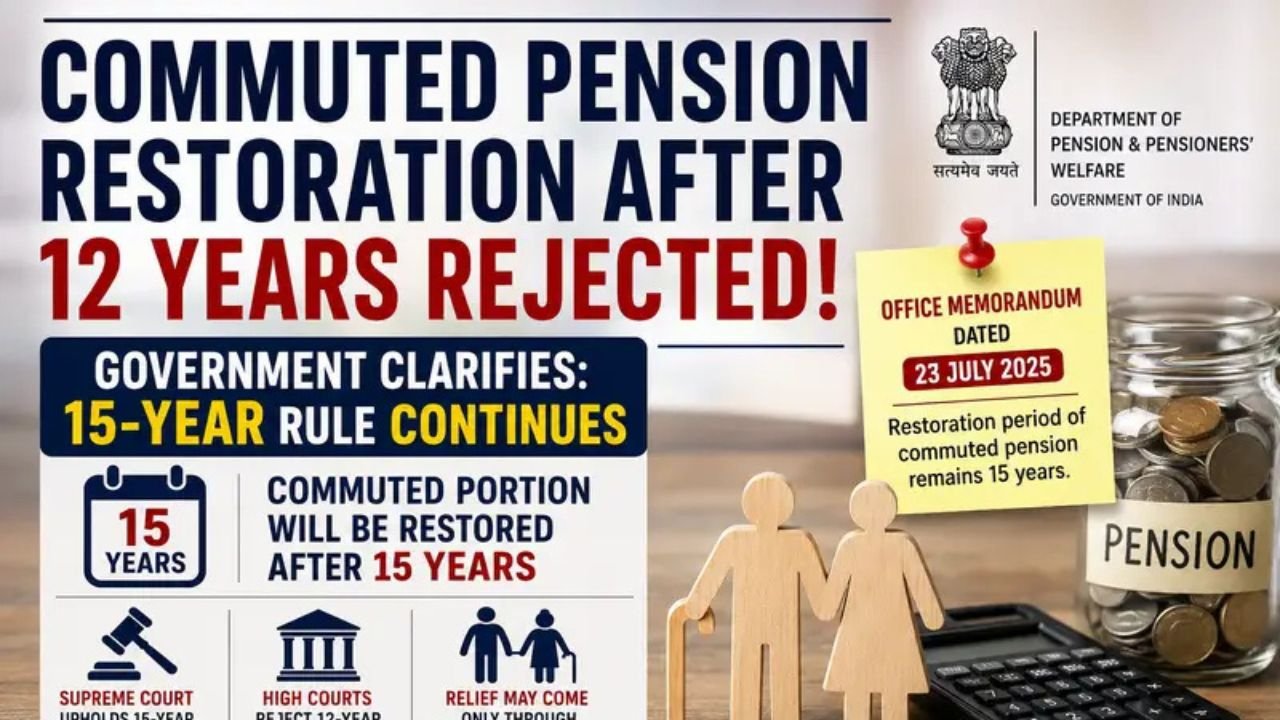
Government Confirms Pension : Many Central Government employees choose to commute a part of their pension when they retire. This means they receive a large lump-sum amount in advance by giving up a portion of their monthly pension. The reduced pension continues for a fixed period. After that period ends, the deducted portion is restored and the pensioner starts receiving the full pension again. This system has been in place for many years and is governed by government pension rules.
Why Pensioners Wanted the Rule Changed
Several pensioners’ associations have been asking the Government to reduce the restoration period from 15 years to 12 years. They believe that the commuted amount is recovered much earlier than 15 years. Many retirees also face rising medical expenses, inflation, and increasing daily living costs. According to these groups, restoring the full pension sooner would provide better financial support during old age and improve the quality of life for pensioners.
Government’s Latest Clarification
The Department of Pension and Pensioners’ Welfare (DoPPW) recently clarified that there is currently no plan to reduce the restoration period. The Government stated that the existing 15-year rule will continue. Officials explained that the matter has already been examined by various courts, including the Supreme Court and High Courts. Based on these decisions, the Government sees no reason to change the current policy at this time.
Important Court Decisions
The Government’s stand is supported by several court judgments. A landmark Supreme Court case in 1987 studied interest rates, life expectancy, and pension calculations before concluding that 15 years was a reasonable restoration period. Later, the Delhi High Court and the Punjab & Haryana High Court also upheld the same policy. When appeals were filed, the Supreme Court refused to interfere, further strengthening the Government’s position on the issue.
Pension Commutation Facts at a Glance
| Topic | Details |
|---|---|
| Scheme Name | Pension Commutation |
| Who Can Use It? | Eligible Government pensioners |
| Main Benefit | Lump-sum payment at retirement |
| Pension Impact | Monthly pension is reduced temporarily |
| Current Restoration Period | 15 years |
| Demand by Pensioners | Reduce period to 12 years |
| Government Decision | No change proposed |
| Governing Rules | Central Civil Services (Pension) Rules, 2021 |
| Key Supreme Court Case | Common Cause Society vs Union of India (1987) |
| Delhi High Court Decision | Supported 15-year rule in 2019 |
| Punjab & Haryana High Court Decision | Rejected 12-year demand in 2024 |
| Future Changes Possible? | Only through Government policy reforms |
What Pensioners Should Know
The latest clarification means pensioners must continue to follow the existing 15-year restoration system. Courts have generally treated pension commutation as a policy matter rather than a legal dispute. Any future reduction in the restoration period would most likely come through Government reforms or recommendations of a future Pay Commission. Until then, the current framework remains fully applicable to eligible Central Government pensioners.
Useful Points for Pensioners
- Full pension restoration currently happens only after 15 years.
- There is no official proposal to reduce the period to 12 years.
- Multiple court decisions support the existing rule.
- Pension commutation remains voluntary for eligible retirees.
- Future changes depend on Government policy decisions.
- Pensioners’ associations may raise the issue before future Pay Commissions.
Frequently Asked Questions (FAQs)
1. Has the Government reduced the restoration period to 12 years?
No. The restoration period remains 15 years.
2. What is pension commutation?
It is a facility that allows pensioners to receive a lump-sum amount by surrendering part of their monthly pension.
3. When is the deducted pension restored?
The commuted portion is restored after completing 15 years from the date of commutation.
4. Why do pensioners want restoration after 12 years?
Many pensioners believe earlier restoration would help them manage rising expenses and healthcare costs.
5. Can courts change the restoration period?
Courts generally consider it a policy matter and have largely supported the Government’s existing rules.
6. Which department handles pension policy?
The Department of Pension and Pensioners’ Welfare (DoPPW) is responsible for pension-related policies.
7. Could the rule change in the future?
Yes, but only if the Government decides to revise the policy or accepts recommendations from a future Pay Commission.
8. Does this rule apply to all Central Government pensioners?
It applies to pensioners covered under the Central Civil Services (Pension) Rules, 2021.